





Retina
Latest News
Advertisement
Latest Videos



CME Content














Advertisement
More News
Dr Yasha S. Modi discusses his best tips and tricks for finding and diagnosing infectious uveitis.
Jeff Cleland, PhD, CEO of Ashvattha, discusses safety data for an at-home subcutaneous anti-VEGF injection option in development for the treatment of wet AMD and DMO.

Increasing understanding of the genetics behind Usher syndrome suggests that treatment may become possible in the very near future.
The OpRegen trial is a cell therapy trial, looking to explore potential safety and efficacy for patients with advanced dry age-related macular degeneration (AMD).

Retina specialists and their patients have learned how AI and telemedicine can be effective in monitoring disease progression and alerting clinicians to early signs of adverse changes.

The study assesses retinal blood biomarkers using a new prototype OCT, aiming to measure retinal biomarkers such as blood flow volume, average velocity and vessel diameter with a new prototype.
The study found that if certain forms of nystagmus that are seen in patients, then there is a higher chance of poor binocular visual function, as well as higher interocular suppression.
Dr Carlos Quezada Ruiz, senior medical director at Genentech, discusses “Predicting optimal treatment regimen for patients with neovascular age-related macular degeneration using machine learning.”

According to Novartis, the approval is based on year 1 data from the Phase III KESTREL and KITE clinical trials investigating brolucizumab-dbll 6 mg vs aflibercept 2 mg in diabetic macular oedema patients.

Prof. Anat Loewenstein discusses data regarding the efficacy of faricimab at targeting both the VEGF and Ang2 pathways in patients with neovascular AMD and diabetic macular oedema.
The Phase 3 integrated PEACHTREE and AZALEA study data revealed strong safety and efficacy for triamcinolone acetonide via suprachoirodal injection.

Promising gene therapies in development are pinpointing steps in the pathogenic cascades involved in ocular diseases, such as VEGF for wet AMD and CFI for dry AMD.

An ischaemia modulator has demonstrated it is safe and well tolerated in a Phase 1/2a trial in diabetic macular ischaemia patients.
Dr Jennifer I. Lim reviews the 2-year results of the YOSEMITE and RHINE trials, outlining the efficacy, durability, and safety of faricimab in diabetic macular oedema.

Dr Eva Chamorro points out that myopia control spectacle lenses affect the diurnal rhythms in the AL in young adult human and produced a small short-term increase in the AL that varies in intensity and time interval for each of the 3 studied lenses.

Investigators from the Karolinska Institutet and St. Erik Eye Hospital, Stockholm, Sweden, reported that they have developed a prognostic test, referred to as serUM, that they believe is a strong predictor of metastasis of uveal melanoma.

THR-687 is currently being evaluated in a phase 2 clinical trial in patients with DME. The first data from the dose-optimization study is expected to be released in the first half of 2022.
Mike Watson, Vice President of OraNet, unpacks some of the most pressing challenges to clinical research in today’s climate.

The study found no association between treatment and the risk of chronic kidney disease or end-stage renal disease.

In a poster presented at the Association for Research in Vision and Ophthalmology’s 2022 annual meeting, Dr Osama Ibrahim Hirayama and colleagues offered results that demonstrating that anisometropia and astigmatic error were greater among the patients with high myopia compared with the other groups. Compared with the subjects with no myopia, those with high myopia reported significantly more dryness, less photophobia, and less pain.
Dr David Bingaman of Ora Clinical discusses today’s need to accelerate clinical studies and increase investments in retina and challenging disease states.
The axitinib intravitreal implant (OTX-TKI) is being evaluated to treat wet age-related macular degeneration in a phase 1b clinical trial.
At ARVO 2022, Dr Jason S. Slakter presents data on the efficacy and safety of OPT-302 when combined with ranibizumab for polypoidal choroidal vasculopathy.
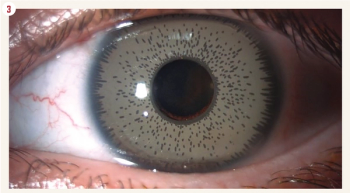
Authors of a retrospective study into complications associated with iris implants advise that the procedure should be considered as malpractice.

In one study of children with solitary unilateral retinoblastoma, the youngest children were found to have the greatest risk for a germline mutation.
Advertisement
Advertisement