
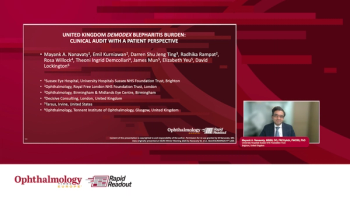
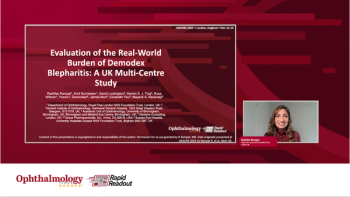
Prof. Nanavaty reviews UK treatment practices, emphasizing that the lack of Demodex-specific therapies leads to mismanagement, increased healthcare burden, and complications, while highlighting the need for better diagnosis and targeted treatment.
Prof. Nanavaty reviews UK treatment practices, emphasizing that the lack of Demodex-specific therapies leads to mismanagement, increased healthcare burden, and complications, while highlighting the need for better diagnosis and targeted treatment.
Prof. Nanavaty outlines Demodex blepharitis, highlights colorette counts as a measure of severity, and emphasizes that despite its high prevalence in patients, it is frequently overlooked and should be routinely assessed during eye exams.

Prof. Anat Loewenstein questioned whether treat-and-extend will remain the preferred strategy as longer-acting therapies emerge.
Andrew G. Lee, MD, presents the “no” perspective on whether GLP-1 agonists cause non-arteritic anterior ischemic optic neuropathy, arguing that current evidence shows association but not proven causation.


Marta Pazos, MD, PhD, examined the role of optical coherence tomography, artificial intelligence, and clinical evaluation in early glaucoma management.
Steffen Hamann, PhD, FEBO, FRCOphth, discusses how optic disc drusen can mimic glaucoma and discussed evolving imaging and research strategies.
Andrew Tatham, MD, MBA, FRCOphth, FEBO, outlines the role of micro-invasive glaucoma surgery alongside established glaucoma procedures, focusing on safety, patient selection, and future directions.
Prof. Dr. med. Wolf A. Lagrèze highlights the clinical role, limitations, and future potential of optical coherence tomography in glaucoma and neuro-ophthalmic disease.

Dr. Curcio highlights volume electron microscopy evidence from a preterm-born adult retina reveals unexpected Müller glial diversity and implications for foveal development.

Research reveals how COVID-19 disrupted anti-VEGF treatment schedules, yet flexible regimens maintain visual outcomes for neovascular AMD patients.

Dr. Sharon Fekrat presented a retrospective analysis assessing how antiplatelet and anticoagulant therapy relates to hemorrhage characteristics and outcomes.
Anat Loewenstein, MD, shared recent research findings which indicate home monitoring is appropriate for atypical and complex pathologies
Continued research shows that earlier treatment significantly enhances tissue preservation in patients with geographic atrophy, emphasizing the importance of timely intervention.

Dr Khanani shared his first-time results talk during an AAO specialty day

Dr Borkar, a vitreoretinal surgeon at Duke University, spoke to the Eye Care Network about her American Academy of Ophthalmology (AAO) presentation

Jean-Francois Korobelnik, MD, shares highlights from the PULSAR extension study showcasing aflibercept 8 mg and its ability to promote fluid resolution
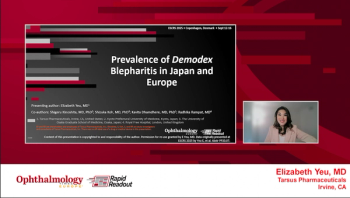
An expert discusses the prevalence and clinical impact of Demodex blepharitis across Japan and Europe, highlighting regional differences in diagnosis and awareness.
Dr Chhablani said "having multiple approaches to the same problem" is key for reaching the maximum number of patients with age-related macular degeneration
Dr Miere presented the ACTOR study, illuminating vascular remodeling in patients with neovascular AMD, and the HERMES study, investigating perfusion changes in central retinal vein occlusion

María Berrocal, MD, spoke about the Vit-Buckle Society (VBS), which has become a regular feature at the European Society of Retina Specialists annual meeting
Prof Romano stressed the importance of matching procedure to patient, not just mastering technical vitrectomy skills
An expert discusses evolving best practices in the diagnosis and management of Demodex blepharitis, highlighting collarettes as pathognomonic and sufficient for diagnosis, the importance of targeting high-risk patient groups for treatment, and the promise of a new pharmacologic therapy that shifts care toward a more effective, flexible, and patient-centered approach.
Today, over 150 practitioners from 20 countries in Australia, Asia and Europe enter their patient data into the Fight Retinal Blindness! Registry
At the EURETINA congress, Prof Boon discussed controversies in treatment, some driven by critical prospective studies
Artificial intelligence is quickly expanding the breadth and depth of information clinicians can interpret, Prof Uy said